
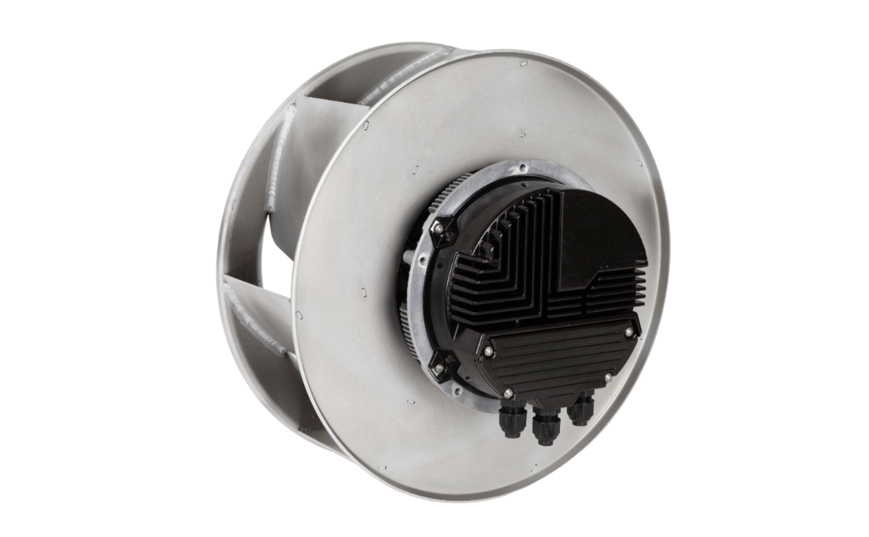
A centrifugal fan’s impeller is one of its most important components because it directly influences how air moves through the system. Its shape, blade configuration, diameter, and rotational speed can affect airflow, pressure generation, efficiency, noise, and overall operating performance. Understanding these factors helps in selecting a fan suited to specific ventilation requirements.
Role of the Impeller in a Centrifugal Fan
The impeller rotates to accelerate air outward from the fan’s centre through centrifugal force. As air gains velocity, the fan casing converts part of that velocity into pressure, allowing air to move through ducts and ventilation systems.
Because the impeller determines how efficiently energy is transferred to the air, its design has a significant effect on the fan’s operating characteristics. Different applications may require different impeller configurations depending on airflow and pressure requirements.
Blade Shape and Configuration
The shape and orientation of impeller blades influence airflow characteristics. Forward-curved blades can generate high airflow at relatively low speeds, while backward-curved blades are often associated with higher efficiency and stable operation. Radial blades can be suitable for applications where durability and resistance to particulate matter are important.
Blade count also affects performance. Adding more blades can influence pressure development and airflow, but excessive blade numbers may increase friction and power requirements. Therefore, impeller geometry needs to be balanced according to the intended operating conditions.
Impeller Diameter and Speed
Impeller diameter plays a major role in determining the volume of air a centrifugal fan can move. Larger impellers can generally produce greater airflow and pressure when operating under appropriate conditions.
Rotational speed also affects fan performance. Increasing speed can significantly increase airflow and pressure, while also increasing power consumption and potentially noise. Proper sizing is therefore essential to prevent unnecessary energy use or mechanical stress.
Impact on Energy Efficiency
An appropriately designed impeller can transfer energy to air efficiently, reducing losses within the fan. Backward-inclined impellers, for example, can provide favourable efficiency characteristics in many ventilation applications.
Efficiency depends on more than the impeller alone. The motor, housing, inlet conditions, ductwork, and operating point all contribute to overall system performance. Working with experienced centrifugal fan manufacturers can help ensure that the impeller and other components are matched correctly.
Effect on Noise and Vibration
Impeller design can also influence acoustic and mechanical behaviour. Poorly balanced components, unsuitable blade geometry, or operation outside the recommended range can contribute to vibration and noise.
Precision manufacturing and proper balancing help maintain smooth rotation. In demanding ventilation environments, centrifugal exhaust fan manufacturers may offer configurations designed around specific airflow, pressure, and operating requirements.
Choosing the Right Impeller Design
Selecting an appropriate impeller requires consideration of airflow volume, static pressure, operating speed, air temperature, particulate content, energy requirements, and duty cycle. The application should determine the design rather than selecting a fan solely by size or airflow rating.
Kohmer can be considered when evaluating centrifugal fan solutions for different industrial and ventilation applications, with selection based on the system’s operating requirements.
Conclusion
Impeller design has a direct relationship with centrifugal fan performance. Blade geometry, diameter, speed, balancing, and construction can affect airflow, pressure, efficiency, noise, and reliability. Evaluating these factors together helps ensure that the selected fan performs effectively within its intended system.
For guidance on centrifugal fan configurations and application requirements, contact Kohmer to discuss the airflow and pressure conditions of your ventilation system.
FAQs
1. Why is impeller design important in centrifugal fans?
Impeller design determines how efficiently energy transfers to air. Blade shape, diameter, and configuration influence airflow, pressure, efficiency, noise, vibration, and overall centrifugal fan operating performance.
2. How does blade shape affect fan performance?
Blade shape affects airflow direction, pressure generation, efficiency, and power consumption. Forward-curved, backward-curved, and radial blades provide different operating characteristics for various ventilation and industrial applications.
3. Does impeller size affect centrifugal fan efficiency?
Yes. Impeller diameter influences airflow and pressure generation. An appropriately sized impeller can meet system requirements efficiently, while unsuitable sizing may increase energy consumption or reduce performance.
4. Can impeller design influence fan noise?
Yes. Blade geometry, rotational speed, balance, and airflow conditions can influence aerodynamic noise and vibration. Properly designed and balanced impellers generally support smoother, quieter fan operation.
5. How should an impeller be selected for an application?
Consider required airflow, static pressure, air temperature, particulate levels, operating speed, energy efficiency, and duty cycle. These factors help determine the appropriate impeller configuration for reliable performance.