
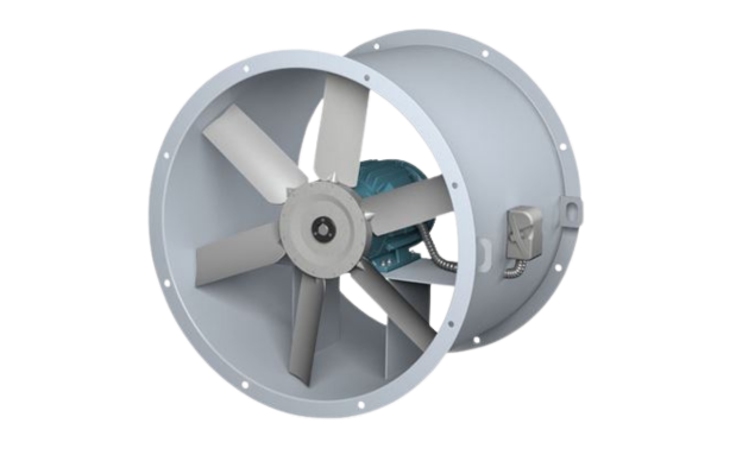
Axial fans are widely used for ventilation, cooling, and air circulation in industrial and commercial environments. However, excessive noise and vibration can affect workplace comfort, increase mechanical stress, and indicate potential equipment problems. Addressing these issues requires proper fan selection, installation, balancing, and regular maintenance.
1. Choose the Right Fan Size
Selecting a fan according to the required airflow and pressure is one of the first steps toward reducing noise and vibration. An undersized fan may need to operate at higher speeds to meet airflow requirements, increasing turbulence, sound levels, and mechanical stress.
A correctly sized fan can operate closer to its intended performance range, helping maintain smoother airflow and quieter operation.
2. Ensure Proper Fan Balancing
Imbalanced rotating components are a common cause of excessive vibration. Even a small imbalance in the impeller or blades can generate significant vibration at high rotational speeds.
Dynamic balancing during manufacturing and after major maintenance can help distribute rotating mass evenly. This reduces vibration and limits unnecessary stress on bearings, shafts, and mounting structures.
3. Maintain Correct Alignment
Misalignment between the fan, motor, shaft, and connected components can create vibration during operation. Proper alignment ensures that rotating components work smoothly without generating excessive mechanical forces.
During installation and maintenance, technicians should inspect shaft alignment, coupling condition, and mounting arrangements to minimize vibration-related problems.
4. Use Stable Mounting and Isolation
A fan that is improperly mounted can transfer vibration to surrounding structures. Loose fasteners, weak supports, or rigid connections may amplify mechanical noise.
Secure mounting, appropriately designed support structures, and vibration-isolation components can help absorb mechanical movement and prevent vibration from spreading through floors, ducts, or equipment frames.
5. Optimize Airflow Conditions
Noise is not always caused by mechanical components. Turbulent airflow can also produce considerable sound. Sharp bends, restricted ducts, poorly positioned dampers, and inadequate inlet or outlet conditions can disturb airflow.
Providing sufficient clearance around the fan and designing smooth airflow paths can reduce turbulence and contribute to quieter operation.
6. Perform Regular Maintenance
Routine inspections can identify developing problems before they become major sources of noise or vibration. Bearings, belts, fasteners, blades, motors, and other components should be checked according to operating conditions and maintenance requirements.
Dust accumulation or damaged blades can also affect fan balance and airflow. Cleaning and timely replacement of worn components help maintain stable performance.
7. Work With Experienced Manufacturers and Suppliers
Choosing equipment from experienced axial fan manufacturers in india can provide access to properly engineered fan configurations suited to specific operating conditions. Product quality, balancing standards, motor selection, and construction can all influence noise and vibration levels.
An experienced axial fans supplier can also help assess airflow requirements and recommend suitable equipment for the intended installation.
Kohmer and Reliable Fan Solutions
Kohmer emphasizes the importance of appropriately engineered air-moving equipment for applications where reliable operation matters. Proper fan selection, installation, balancing, and maintenance can collectively contribute to smoother and quieter performance.
Conclusion
Reducing axial fan noise and vibration requires attention to the complete system rather than a single component. Correct sizing, balancing, alignment, mounting, airflow design, and preventive maintenance can significantly improve operating stability while reducing unnecessary mechanical and aerodynamic noise.
For assistance with selecting or optimizing axial fan solutions, contact Kohmer to discuss your application requirements and equipment needs.
FAQs
1. What causes excessive vibration in axial fans?
Excessive vibration can result from unbalanced blades, misalignment, loose mounting, worn bearings, damaged components, or operating conditions that place excessive mechanical loads on rotating parts.
2. How can axial fan noise be reduced?
Noise can be reduced through proper fan sizing, balanced components, smoother airflow paths, appropriate mounting, vibration isolation, regular maintenance, and avoiding excessive rotational speeds during operation.
3. Does fan speed affect noise levels?
Yes. Higher rotational speeds generally increase aerodynamic and mechanical noise. Operating a correctly sized fan at an appropriate speed can help achieve required airflow with lower noise levels.
4. Why is balancing important for axial fans?
Balancing distributes rotating mass evenly around the fan assembly. This minimizes centrifugal forces, reduces vibration, protects mechanical components, and supports smoother, more reliable fan operation.
5. Can poor installation increase fan vibration?
Yes. Incorrect alignment, loose fasteners, inadequate supports, and unsuitable connections can amplify vibration. Proper installation ensures the fan remains stable and operates within its intended conditions.