
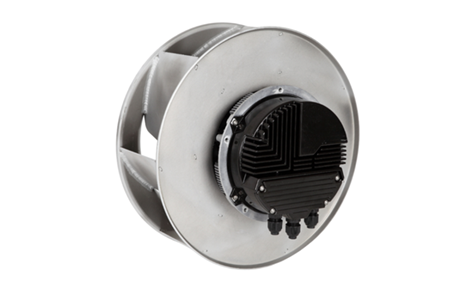
Selecting the right industrial fan is a critical engineering decision that dictates long-term plant reliability. Engineers frequently select axial fans purely for their efficiency advantages, without considering the maintenance reality. However, a 2% efficiency gain means nothing if the fan requires a shutdown every six months for cleaning, versus an annual outage for an equivalent centrifugal design. Understanding the fundamental differences between these technologies is essential.
Structural Stress and Failure Modes
The physics governing these two designs are entirely distinct.
- Axial Fans: The primary stress on these units is bending fatigue at the blade roots and cyclic aerodynamic loading. Because of this, their failure modes typically manifest as blade root cracks, hub fatigue, or inlet guide vane failures.
- Centrifugal Fans: These impellers must withstand centrifugal stress, backplate bending, and thermal gradients. Consequently, their common failure modes include backplate cracking, shaft fatigue, and scroll structural failure.
Ideal Applications and Performance
Knowing when each fan excels prevents catastrophic misapplication in the field.
- When Axial Excels: These are the superior choice for high flow, low-to-medium pressure applications. They are perfect for space-constrained inline installations and require clean gas service with minimal particulate. As any knowledgeable axial fans supplier will note, they are highly sensitive to tip clearances; a mere 0.5 mm gap equates to a 3% efficiency loss.
- When Centrifugal Dominates: These dominate when the process demands high pressure rise requirements exceeding 5 kPa. Top centrifugal fan manufacturers in India recommend them for high-temperature applications above 400°C and for dirty or particulate-laden gas streams.
Maintenance Access and Fouling Impact|
Maintenance accessibility and response to dirt dictate the true cost of ownership.
- Maintenance access for axial fans is excellent because the blades are exposed, allowing for easy inspection and cleaning. However, the impact of fouling is immediate, leading to efficiency loss, unbalance, and increased vibration.
- Conversely, centrifugal fans offer poor maintenance access because scroll disassembly is required to reach the buried impeller. Despite this, they handle fouling much better, showing only gradual performance degradation until catastrophic unbalance eventually occurs.
Expected Lifespan and Vibration
Vibration in axial fans typically originates from blade passing frequency, rotating stall, or inlet distortion. Their typical life limit is defined by blade fatigue at 20 to 30 years, and bearing wear at 5 to 10 years. Centrifugal fan vibration often stems from blade passing at the scroll tongue, surge, or impeller unbalance. Their life limit is generally dictated by backplate cracking at 25 to 40 years, with bearing wear at 3 to 8 years.
Partner With Kohmer
Choosing between axial and centrifugal technologies requires aligning equipment geometry with the exact field realities of your facility. At Kohmer, we are a leading industrial fan manufacturer dedicated to bridging the gap between theoretical efficiency and rugged field reliability. We engineer robust fan solutions designed to handle the true stresses of your specific operational environment.