
Manufacturing environments often generate heat, dust, fumes, and airborne contaminants that can affect equipment performance and workplace comfort. Effective ventilation helps maintain suitable working conditions by continuously moving air through production areas. Axial fans are widely used for this purpose because they can move large volumes of air efficiently across industrial spaces.
What Are Axial Fans?
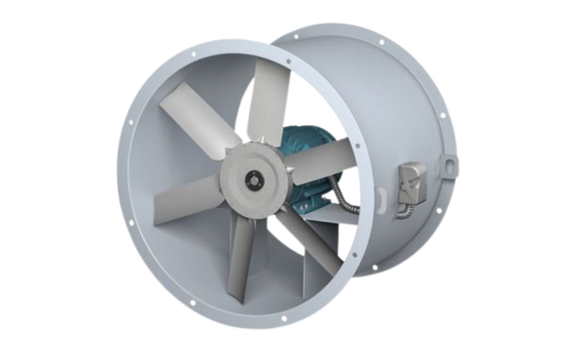
Axial fans are ventilation devices designed to move air parallel to the fan shaft. Their blades rotate around a central axis, drawing air into the fan and pushing it forward. This design allows axial fans to deliver high airflow rates, making them suitable for factories, warehouses, workshops, and other large facilities.
Unlike systems designed primarily for high-pressure applications, axial fans are generally preferred when substantial air movement is required across relatively open spaces. Their straightforward design also allows them to be incorporated into different ventilation configurations.
How Axial Fans Improve Manufacturing Ventilation
Manufacturing processes can produce significant amounts of heat and airborne pollutants. Without adequate airflow, these conditions can accumulate and create an uncomfortable or inefficient work environment. Axial fans help circulate fresh air while removing hot or contaminated air from production areas.
They can be installed as wall-mounted, roof-mounted, ducted, or exhaust units depending on the facility’s ventilation requirements. Strategic placement can help create consistent airflow throughout the workspace and reduce stagnant-air zones.
Axial fans can also support temperature management. By continuously moving air, they help disperse heat generated by machinery and production processes. This can contribute to a more comfortable environment for workers while helping prevent excessive heat buildup around equipment.
Choosing the Right Axial Fan
Selecting an appropriate fan requires consideration of factors such as airflow volume, operating environment, fan diameter, motor capacity, installation location, and noise levels. Facilities should also consider whether the fan will handle clean air, dust, moisture, fumes, or other challenging conditions.
Working with experienced axial flow fan manufacturers can help businesses identify equipment that matches their specific ventilation requirements. Proper sizing is particularly important because an undersized fan may not provide sufficient airflow, while an unnecessarily large unit can increase energy consumption and operating costs.
Reliable equipment selection is equally important in demanding industrial environments. Industrial axial fans manufacturers typically offer different configurations and specifications to accommodate varying airflow and installation requirements.
Supporting Efficient Industrial Operations
A well-planned ventilation system can contribute to better workplace conditions, improved temperature control, and more consistent air circulation. When combined with suitable installation and routine maintenance, axial fans can provide dependable airflow for demanding manufacturing applications.
Kohmer can be considered when evaluating ventilation solutions for industrial environments, particularly where reliable air movement is an important part of facility operations. The right fan configuration should always be selected according to the facility’s airflow requirements and operating conditions.
Conclusion
Axial fans provide an effective way to move large volumes of air throughout manufacturing facilities. From controlling heat to improving air circulation, their versatility makes them valuable components of industrial ventilation systems. Proper fan selection, positioning, and maintenance can help facilities achieve consistent and efficient airflow.
Looking for the right ventilation solution for your manufacturing facility? Contact Kohmer to discuss your industrial airflow requirements and identify a suitable axial fan configuration for your application.
FAQs
1. What are axial fans used for in manufacturing facilities?
Axial fans are used to circulate large volumes of air, remove heat, improve ventilation, exhaust airborne contaminants, and maintain more comfortable conditions across manufacturing and industrial workspaces.
2. How do axial fans improve factory ventilation?
Axial fans continuously move air through production areas, helping replace stagnant air, disperse accumulated heat, and support the removal of fumes, dust, and other airborne pollutants.
3. Where can axial fans be installed in industrial facilities?
Depending on ventilation requirements, axial fans can be installed on walls, roofs, ducts, or exhaust points to create effective airflow patterns throughout manufacturing and warehouse environments.
4. How should an axial fan be selected for a factory?
Selection should consider required airflow, facility size, installation location, operating temperature, environmental conditions, motor capacity, noise levels, and whether the fan handles dust or moisture.
5. Do axial fans require regular maintenance?
Yes. Routine maintenance should include inspecting blades, motors, bearings, mounting components, and electrical connections while cleaning accumulated dust to maintain reliable airflow and efficient operation.