
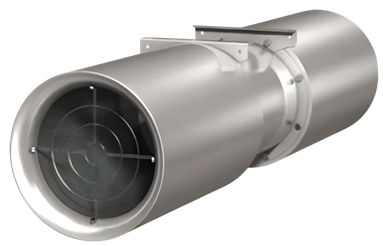
Jet fans are the undisputed workhorses of modern ventilation systems. Whether they are actively exhausting toxic carbon monoxide from a sprawling underground commercial car park or controlling deadly smoke during a subterranean tunnel fire, their reliability is literally a matter of life and safety. However, investing in top-of-the-line aerodynamic equipment is only half the equation. Even the most powerful and heavily engineered jet fan will severely underperform if it is not installed and commissioned flawlessly.
Understanding the transition from a manufactured product to a fully operational life-safety system reveals exactly why professional installation and meticulous commissioning are non-negotiable.
1. The Criticality of Precision Positioning
Jet fans operate purely on the principle of impulse technology. They transfer high-velocity momentum to the surrounding stagnant air to create a continuous, directed airflow toward the main exhaust shafts. If a fan is installed too close to a ceiling downstand, a structural beam, or a corner wall, it triggers the “Coandă effect”—a phenomenon where the high-speed airstream clings to the adjacent surface. This causes massive aerodynamic friction, turbulent airflow, and a severe loss of effective thrust. Proper installation strictly follows advanced Computational Fluid Dynamics (CFD) models to position every single unit at the optimal angle and clearance, ensuring the air throw remains unobstructed.
2. Vibration Isolation and Structural Integrity
Operating at high speeds, these units naturally generate significant rotational forces. Improper mounting not only leads to distracting noise pollution that echoes throughout a facility but also causes chronic mechanical fatigue to the equipment. Expert installation teams utilize specialized spring or rubber anti-vibration mounts and strictly adhere to rigorous structural load calculations. This attention to detail ensures that dynamic forces are safely absorbed, protecting both the fan’s internal motor bearings and the building’s structural integrity over decades of continuous operation.
3. Intelligent System Integration
Commissioning is the critical phase where raw hardware actually becomes an intelligent life-safety system. A modern jet fan does not operate in isolation. During the commissioning process, specialized engineers meticulously integrate the fans with central Building Management Systems (BMS), Variable Frequency Drives (VFDs), and sensitive environmental sensors (like CO and NOx detectors). Proper calibration guarantees the system ramps up instantly to clear localized pollution spikes and responds decisively to fire alarm control panels to manage designated smoke control zones.
4. Real-World Performance Validation
A life-safety system cannot be handed over based on theoretical factory calculations alone. Rigorous commissioning involves practical, on-site performance validation. This includes cold and hot smoke testing to visually confirm designed airflow patterns, anemometer readings to verify air velocities, and precise thrust measurements. This level of thorough validation is exactly what sets elite industrial fan suppliers apart from mere equipment distributors.
Secure Peak Performance with Kohmer
Achieving this level of operational excellence requires a partner who understands the complete lifecycle of heavy-duty ventilation. While there are several jet fan manufacturers in India, Kohmer stands out by engineering complete, end-to-end airflow solutions. As a premier industrial fan manufacturer, we do not just build robust, high-efficiency equipment; we provide the deep technical expertise required to ensure our products integrate seamlessly into your infrastructure, delivering uncompromising safety and peak performance from day one.
Do not leave your facility’s critical ventilation to chance. Contact Kohmer today to discuss your next project, and let us help you design and deploy a high-performance jet fan system tailored to your exact operational requirements.